
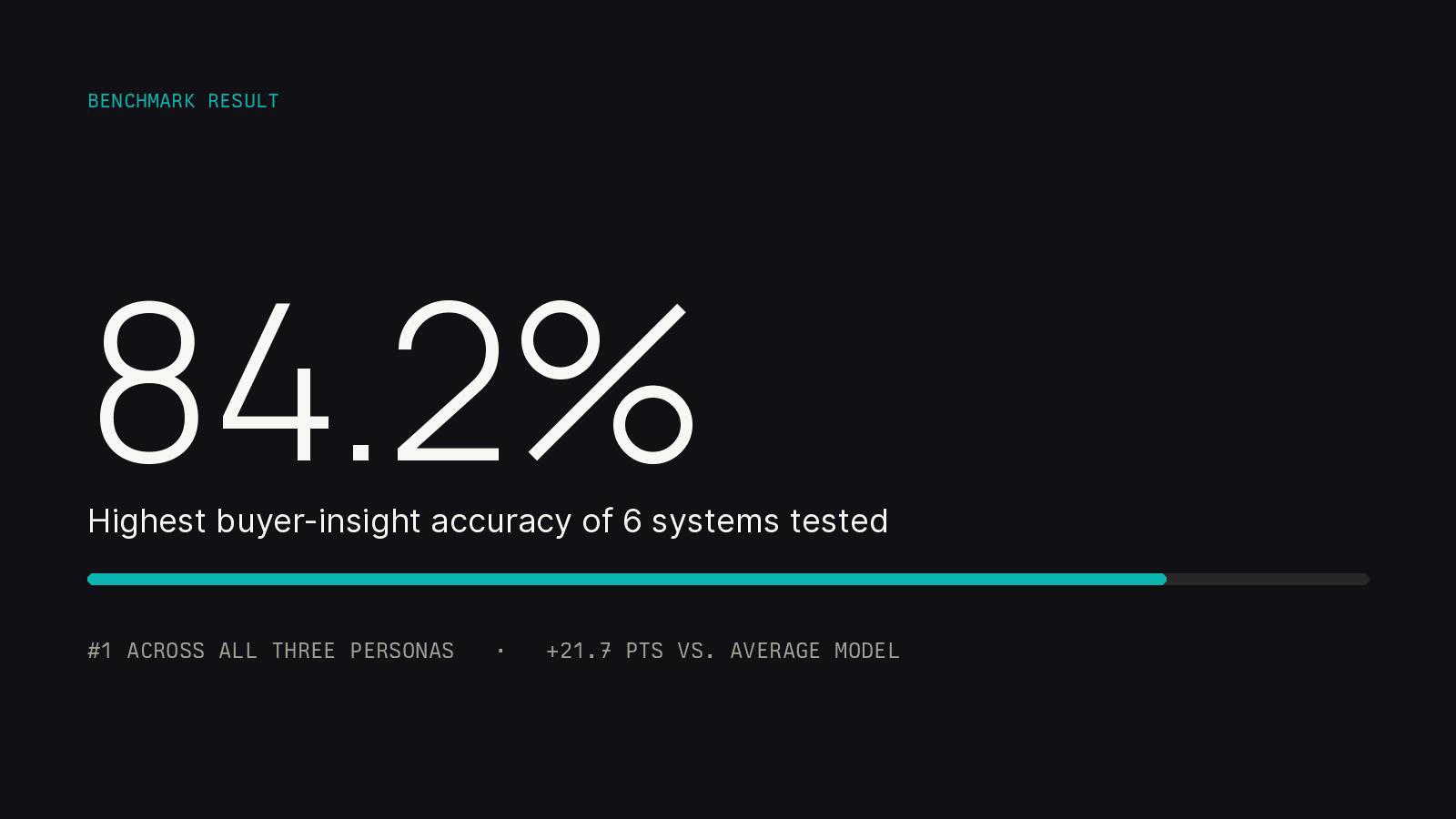
Decisions Lab was benchmarked against five proprietary AI models to test how precisely each system could recover buyer-persona insights from real customer call evidence. The question was not whether a model could write a fluent persona summary. The question was whether its insights stayed anchored to what customers had actually said.
The benchmark measures GTM precision, not generic AI fluency
Generic models often identified the broad customer category, then drifted into familiar SaaS, security, finance, procurement, or enterprise-buying narratives that were not supported by the customer evidence. A buyer insight does not need to be completely wrong to distort a GTM plan. It only needs to shift the team toward the wrong message, objection, proof point, or segment.
What was tested
Six systems were evaluated across three buyer personas. Real customer call evidence, drawn from over a year of call notes, served as the ground truth.
What precision means
Of all generated buyer insights, how many were actually supported by customer evidence?
Why it matters
Unsupported claims can push teams toward the wrong segment, message, proof point, or objection strategy.
How the accuracy rate was calculated
The benchmark tested whether each system could recover buyer psychology from real customer evidence, not whether it could write convincing persona summaries.
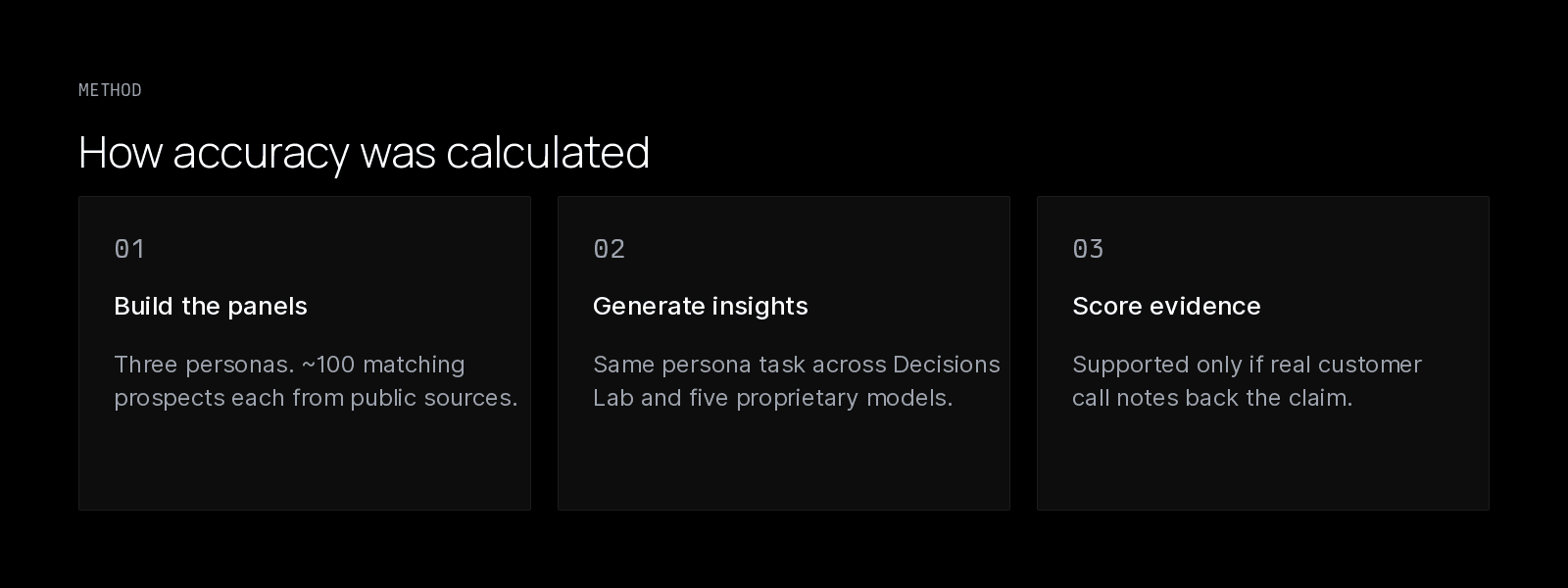
01 Build the panels
Three buyer personas were defined from specific prospect criteria, including company size, IT team structure, role, and operational setup. For each persona, Decisions Lab identified roughly 100 matching real-world prospects by cross-checking public sources such as LinkedIn profiles, company pages, job postings, company structure, and public activity.
02 Generate buyer insights
Those prospects powered simulated customer interviews. Decisions Lab aggregated the responses into buyer insights covering pain triggers, buying triggers, beliefs, objections, aha moments, and decision criteria. The same persona-analysis task went to five proprietary AI models, each asked to role-play the same buyer personas and generate equivalent buyer-insight outputs.
03 Score against evidence
Every generated insight was compared against ground-truth insights from a real customer. An insight counted as supported if the evidence backed it. It counted as unsupported if it introduced an assumption not present in the evidence and could meaningfully shift GTM strategy in the wrong direction.
Accuracy rate = supported insights / total evaluated insights. Consistency = variation in accuracy across the three personas.
Decisions Lab recorded the highest supported-insight rate
Each percentage is the share of generated buyer insights supported by real customer call evidence.
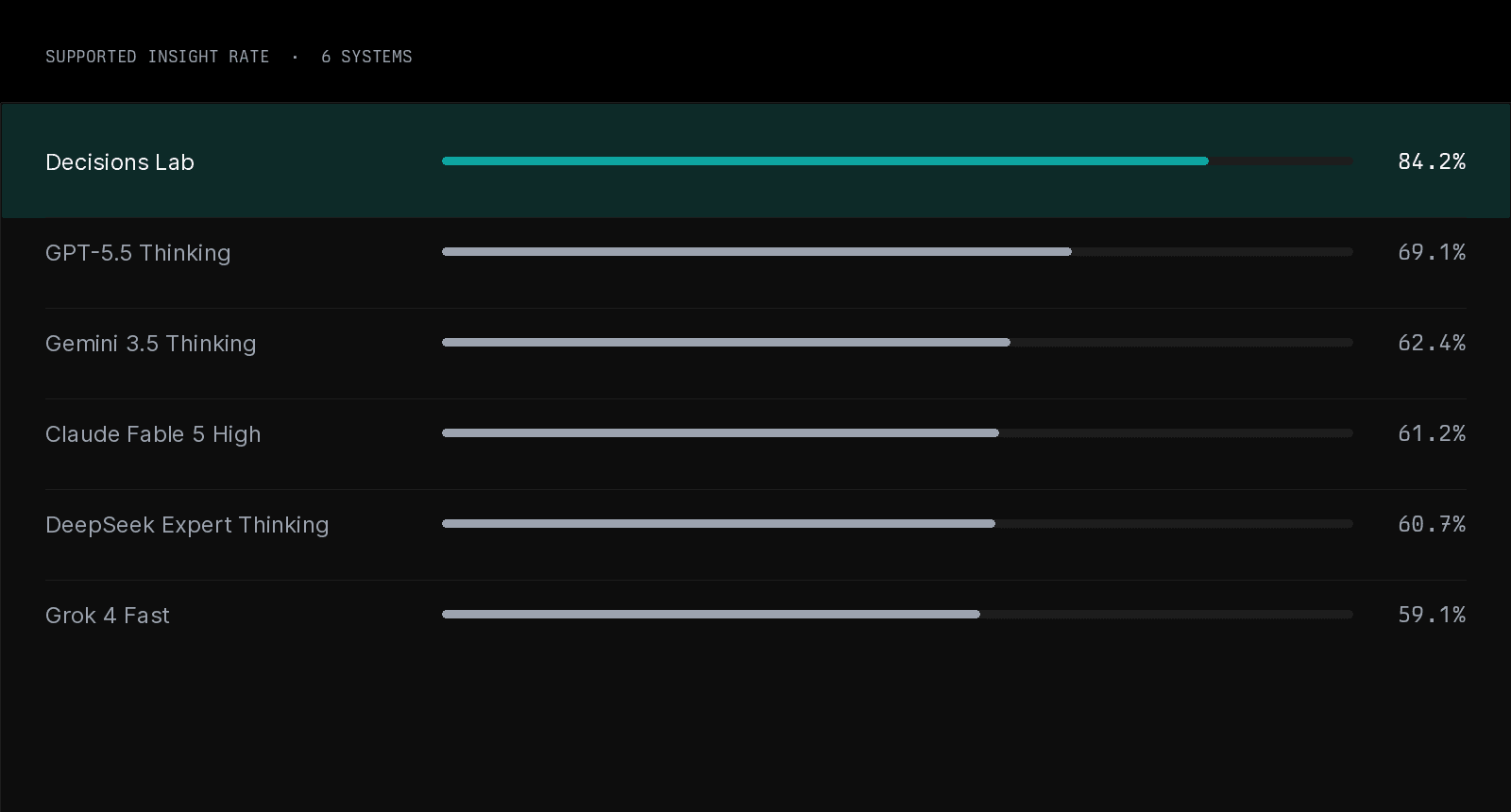
Decisions Lab’s 84.2% average created a +21.7 percentage-point advantage versus the average proprietary model at 62.5%.
Supported-insight rates held across the three buyer personas
The overall ranking held when results were broken out by persona. Decisions Lab led on every persona run.
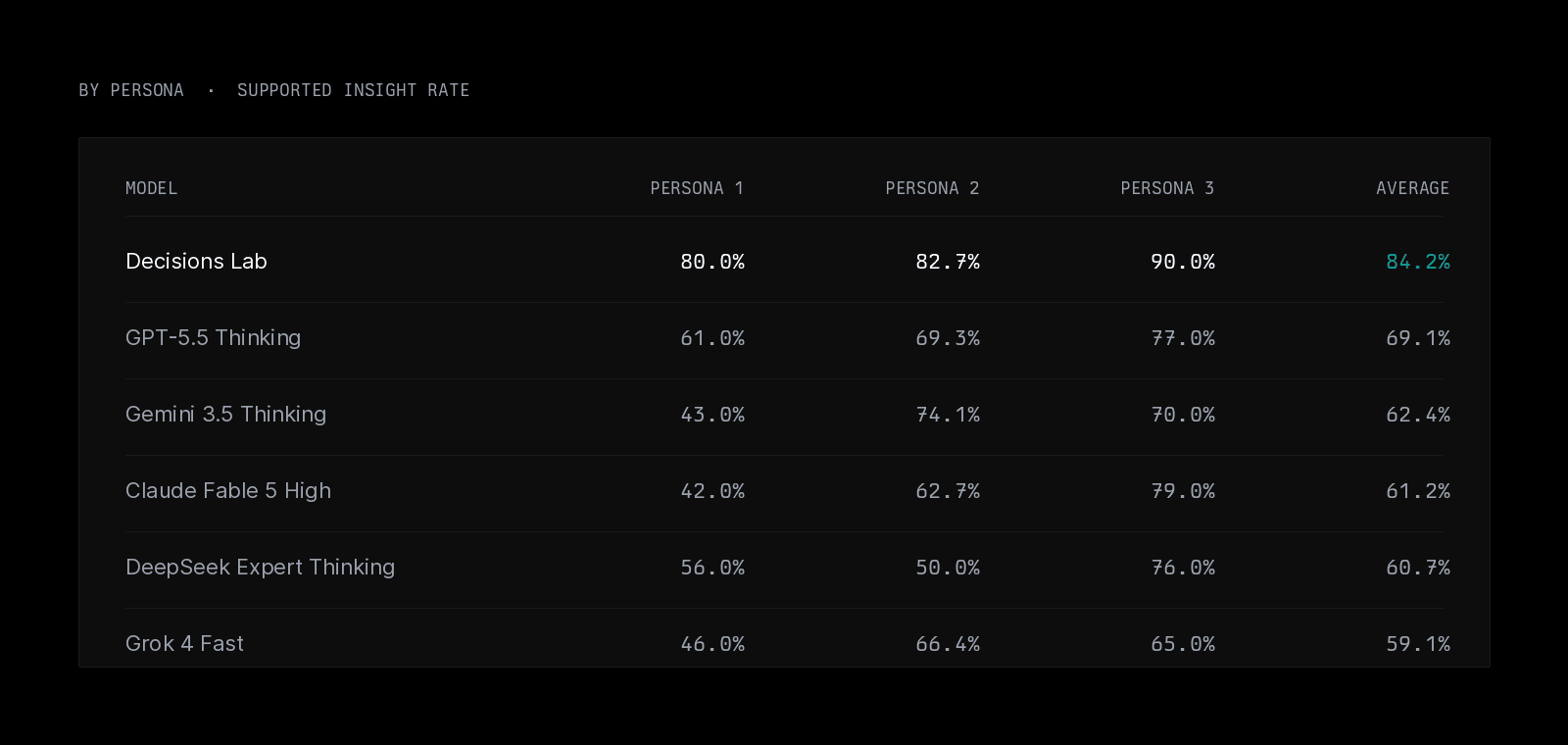
Accuracy matters only when it holds across buyer types
Consistency was measured by comparing each system’s accuracy across the three personas. Lower variation means the system was less likely to perform well on one persona and drift on another. Decisions Lab was 7.6x more consistent than the average external model on this variance measure.
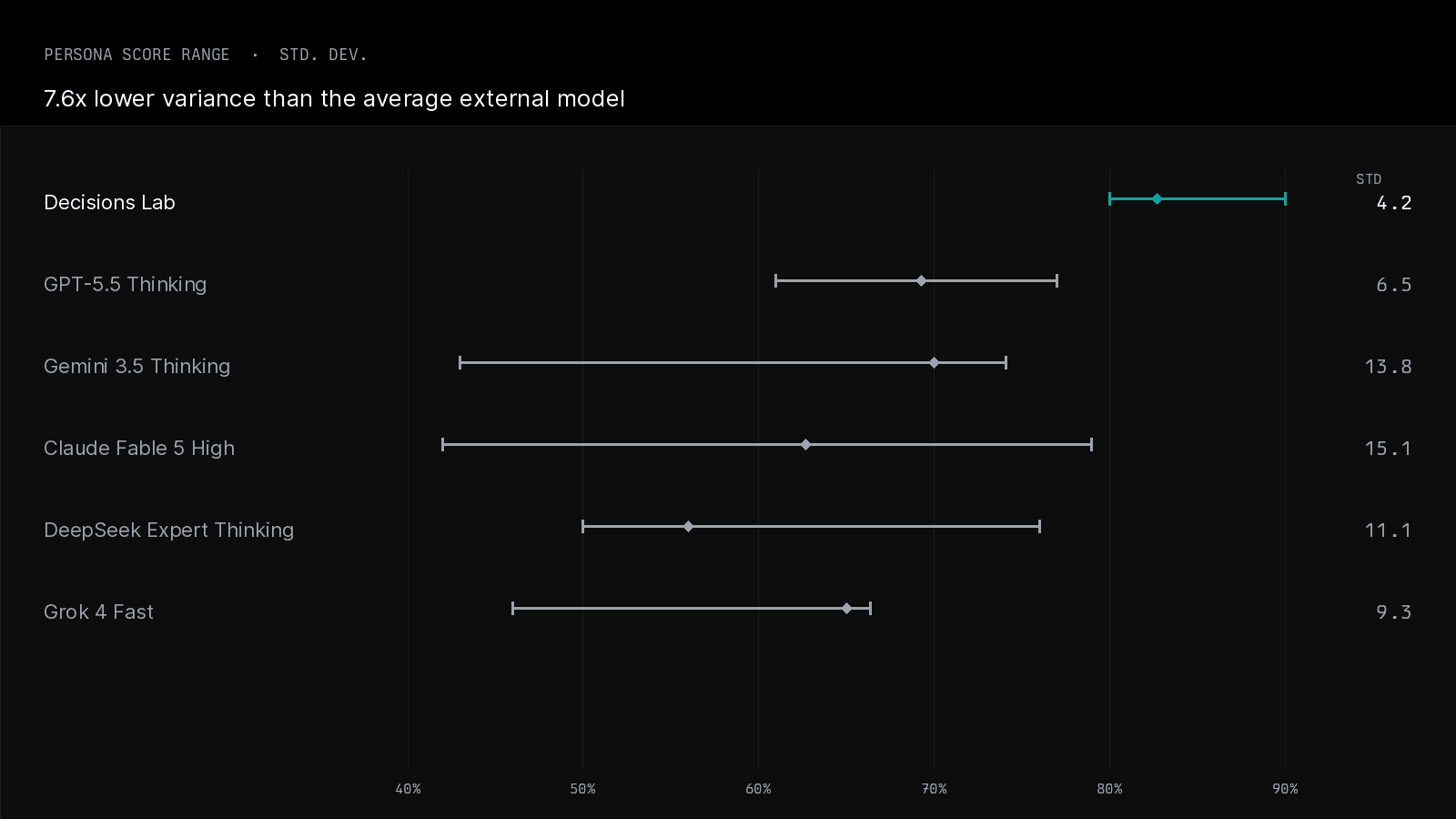
Each row shows the lowest, median, and highest persona score for one system. A shorter range and lower standard deviation means the model is more stable across buyer types.
Different models failed in different ways
The main difference was not writing quality. Most models produced fluent analysis. The difference was evidence discipline: whether the system stayed anchored to what real customers had actually said.
- Decisions Lab stayed closest to the evidence and preserved the core buyer psychology across personas.
- GPT-5.5 Thinking produced relatively strong outputs, but often expanded into too many adjacent points, increasing the chance of unsupported claims.
- Gemini 3.5 Thinking often identified the broad persona category, then added adjacent examples that were not grounded in the call evidence.
- Claude Fable 5 High produced polished and coherent summaries, but sometimes over-smoothed the psychology into generic B2B narratives.
- DeepSeek Expert Thinking showed uneven performance across personas, with stronger results in some cases and larger drift in others.
- Grok 4 Fast generated plausible but less stable insights, with weaker evidence discipline across personas.
The benchmark rewards evidence discipline
The benchmark does not reward the longest or most polished answer. It rewards evidence discipline: the ability to recover the right buyer psychology without drifting into plausible but unsupported assumptions. Decisions Lab was more accurate and more reliable across buyer types, which reduces the risk that those assumptions distort GTM strategy.